Turn Your PD Ratings Into Winning Strategy

Permanent disability (PD) ratings play a central role in the outcome of California workers’ compensation cases, which is why my focus at Gemini Legal is to help clients calculate ratings. They shape settlement value, determine benefit levels, and often influence whether a case resolves smoothly or turns into a prolonged dispute.
Yet PD ratings are rarely as objective as they appear. Even when the math is correct, the inputs that drive the final number are often incomplete, vague, or inconsistently interpreted. The result is that many cases settle on ratings that are technically valid, but not fully accurate or defensible.
This article breaks down where PD ratings commonly go wrong, what separates a thorough rating from a rough estimate, and how attorneys can protect both case value and client outcomes through better process and better tools.
What are Permanent Disability Ratings?
In California workers’ compensation, a permanent disability rating represents the degree to which an injured worker’s impairment limits their ability to compete in the open labor market. It is a crucial element in workers’ compensation cases as it determines the overall value of your long-term disability compensation.
The higher the permanent disability rating percentage, the more money and benefits injured workers are eligible to receive. For example, workers with a rating of 70% to 99% are eligible to receive a lifelong supplemental pension after their standard disability payments are exhausted and those with a 100% rating are eligible for lifetime wage-replacement payments and ongoing medical care.
How are Permanent Disability Ratings Calculated in California Workers’ Comp?
The rating is typically based on:
A medical evaluator’s findings as to physical and mental impairment, also known as whole person impairment (WPI)
The American Medical Association (AMA) guides to the evaluation of permanent impairment
Adjustments for occupation and age
The Permanent Disability Rating Schedule (PDRS) (download here)
Relevant case law and statutory rules
The rating ultimately translates into a percentage of permanent disability, which determines the value and duration of benefits.
While the output is numerical, the process that leads to that number is interpretive. Attorneys are not just working with formulas. They are working with medical narratives, judgment calls, and evolving legal standards. Too often, however, there is a lack of clarity in these inputs, which leaves room for confusion and error that can harm your client’s case.
Why are Many PD Ratings Incomplete?
Many PD ratings are not “wrong” in the sense that the calculation failed. Rather, they are “incomplete” because the underlying inputs were unclear or underdeveloped.
Medical Evaluator Reports Are Often Vague
Medical-legal reports frequently leave room for interpretation. Impairment descriptions may be incomplete, body parts may be ambiguously categorized, or functional limitations may not be clearly tied to the AMA Guides. When the report from the qualified medical examiner (QME) or independent medical examiner (IME) lacks specificity, the rating becomes an educated guess rather than a fully supported conclusion.
Occupation Coding Is Easy to Get Wrong
Occupation adjustments materially affect PD ratings, yet occupation coding is one of the most common sources of error. Many job titles map to multiple classifications with very different labor demands. Selecting the wrong occupational code can materially distort the final rating and settlement value.
Interpretations of AMA Guides Can Vary
The AMA Guides are intended to create consistency, but evaluators have interpretive leeway. In some cases the interpretation can step outside the framework or apply methodology inconsistently. When this happens, the resulting rating may look authoritative while resting on weak analytical ground.
The Rating Schedule Lags Real-World Work Conditions
The PD schedule and occupational frameworks do not always reflect modern work realities, including changes in labor demands, technology, and workforce composition. This creates friction between how injuries affect workers today and how impairment is formally measured.
Why It Matters if PD Ratings Calculations are Incomplete
There is a meaningful difference between a defensible PD rating, and what amounts to a rough estimate due to incomplete inputs.
A detailed and thorough rating:
Aligns tightly with the medical evidence
Applies the AMA Guides consistently
Uses correct occupational coding
Accounts for current case law and statutory guidance
Produces a result that can be explained and defended
A rough estimate may still generate a percentage, but it increases risk in three areas:
Settlement Value Risk
Underrated impairment can leave real value on the table for injured workers. Overstated impairment can create credibility issues in negotiation.Litigation Risk
Weak ratings are easier to challenge. Opposing counsel can attack assumptions, methodology, and inputs, which increases disputes and prolongs resolution.Client Trust Risk
Clients expect their attorney to advocate for a complete and accurate valuation of their claim. When ratings shift late in the process due to errors or omissions, confidence erodes.
Practical Steps Attorneys Can Take to Improve PD Rating Accuracy
Attorneys don’t need to become rating specialists to improve outcomes. A few process changes can materially raise the quality of PD ratings:
Push for clarity in medical reports. Ask for specifics when impairment language is vague.
Validate occupation codes. Do not rely on surface-level job titles. Confirm the functional demands.
Stay current on rating law. Even small doctrinal shifts can change outcomes.
Use calculators as verification tools. Treat outputs as checkpoints, not final truth.
Document your assumptions. If a rating is challenged, you should be able to explain how you arrived at each input.
Over time, these habits reduce downstream disputes and improve settlement posture.
When & Why Attorneys Should Clarify Medical Rating Decisions
The best practice in #1 in the previous section – pushing for clarity in medical reports – is often misunderstood and seen as an aggressive action. However, asking questions about an evaluator’s report is not about being adversarial, it’s about seeking precision.
Attorneys should consider challenging or seeking clarification when:
The impairment description is vague or incomplete
The evaluator departs from the AMA Guides without explanation
The rating methodology is inconsistent with current case law
Functional limitations are described but not translated into impairment values
Occupational demands are not properly considered
Doctors are pressured to declare premature maximum medical improvement (MMI)
Insurers deny symptoms not visible on imaging
Citing relevant precedent and statutory standards matters here. Case law such as Alvarez/Guzman and Kite has shaped how impairment ratings can be challenged and defended. Attorneys who understand these frameworks are better positioned to advocate for ratings that reflect the full scope of the injury.
What Features Should A Good PD Calculator Have?
As noted above in best practice #4, PD calculators are essential in modern workers’ compensation practice. They reduce manual error, speed up analysis, and bring consistency to complex rating logic. However, calculators do not solve input problems on their own.
A strong calculator workflow should:
Support multiple body parts and injury combinations
Make occupation selection easier and more precise
Apply current schedules and case law logic
Produce transparent outputs that can be referenced in court
Reduce the risk of hidden assumptions in calculations
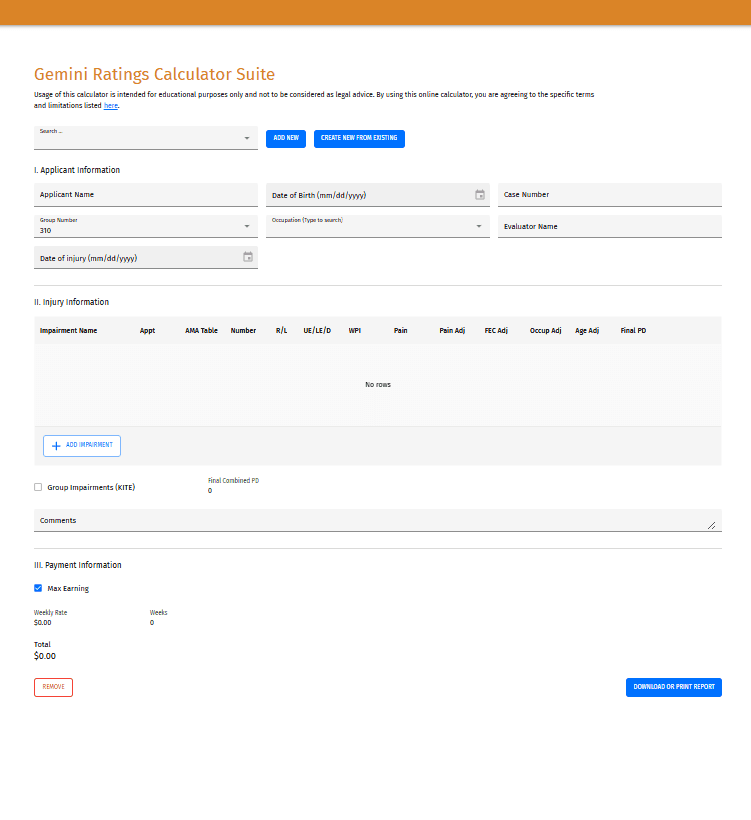
You can see an example of a free calculator that includes these best practices in the Gemini Legal PD Ratings Calculator.
Even with good tools, though, attorneys still need to exercise judgment. The calculator reflects what is entered. If the medical evidence is vague or the occupational classification is off, the output will reflect those limitations.
The real value of modern rating tools is not just speed—it’s defensibility. Transparent calculations allow attorneys to explain how a number was reached, challenge opposing ratings more effectively, and justify their position with confidence.
Final Thought: Treat Ratings Like Strategy
Permanent disability ratings sit at the intersection of medicine, law, and negotiation. They shape leverage, credibility, and client outcomes. Treating ratings as a purely administrative step leaves value on the table and introduces unnecessary risk.
Attorneys who invest in clearer inputs, current standards, and defensible calculation workflows are better positioned to protect their clients and strengthen their cases. The difference between a rough estimate and a well-supported rating is often the difference between a fragile settlement and a durable one.
Brent Shephard
Rating Consultant
Brent Shepherd is a Rating Consultant with 15+ years of experience in workers’ compensation, where he has built deep expertise in ratings, program development, and med-legal operations. He has a strong background in analyzing cases, reviews, discrepancies, and settlements, while also leading technology and software development initiatives, including databases and applications. Brent combines workers’ compensation knowledge with client support and program development experience, bringing a practical, solutions-focused approach to legal and operational workflows.